Between Harvests: How Coffee Farmers Survive the Rest of the Year
Coffee only pays once a year. Discover how small coffee farmers in Colombia survive the months between harvests through side ventures like raising hens, growing plantain, or yuca.
OUR VALUES
Jorge from My Little Coffee Tree
7/22/20263 min read
There is a question people rarely think to ask about coffee farming: what does a farmer live on the other 11 months of the year?
Coffee doesn't pay every week. It doesn't pay every month. In most cases, it pays once during harvest season. And for many small farmers, that single payday is not enough to cover an entire year of living expenses, tools, food, and the countless small costs that never stop showing up.
So the real question becomes: how does a coffee farm survive the months when there is no coffee income at all?
The Math Most People Never Consider
Coffee is a seasonal crop. The cherries ripen, get harvested, get processed, and get sold, and then the trees go back to growing quietly for months before the cycle repeats.
That means a coffee farmer's income arrives in one concentrated window. If that harvest income needs to stretch across 12 months of food, family expenses, tools, repairs, and unexpected costs, the numbers rarely work out evenly.
This isn't a Villa Blanca problem. It's the reality for small coffee farms across Colombia and much of the coffee-growing world.
The Solution: The Farm Becomes More Than Coffee
Here is something we've learned firsthand at Villa Blanca: a coffee farm is never just a coffee farm.
To bridge the gap between harvests, farmers turn to whatever the land can offer. Every farm finds its own version of this solution, depending on soil, climate, and what simply grows well in that specific patch of mountain.
Some farmers plant plantain. Others grow yuca. Some raise pigs. Each of these becomes a secondary income stream, something to sell or trade during the long stretch of months when coffee isn't ready yet.
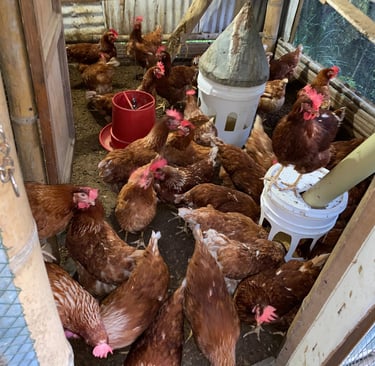
At Villa Blanca, our answer has feathers.
Why We Raise Laying Hens at Villa Blanca
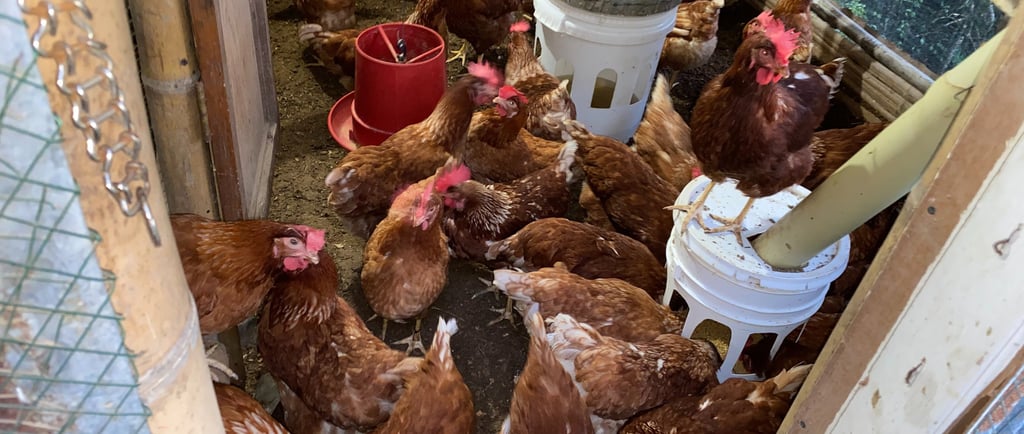
Walk into our henhouse, and you'll find dozens of hens, all busy, all a little chaotic, all doing exactly what they're meant to do: producing eggs.
These eggs serve two purposes. Some feed our own family and the workers on the farm, a direct, practical way to reduce food costs. The rest are sold locally, creating a small but steady stream of income during the months when the coffee trees are simply growing, with nothing yet to harvest.
It isn't a large operation. It doesn't need to be. The goal isn't to build an egg business; it's to create enough stability to get from one coffee harvest to the next without falling into financial strain.
This Is the Part of Farming Nobody Photographs
Coffee farming is often romanticized: sunrise over green hills, red cherries glowing in the light, a farmer's hands sorting perfect beans.
All of that is real. But so is this: a farmer waking up before dawn to feed hens, collect eggs, and figure out how to make ends meet in a month with no coffee income at all.
This is the invisible labor behind your cup of coffee. Not just growing the trees, but building an entire system of survival around them.
Why This Matters for Adopters
When you adopt a coffee tree at Villa Blanca Farm, you are supporting more than a plant. You are supporting a farmer who is constantly problem-solving, managing coffee, hens, crops, and whatever else it takes to make the year work financially.
Every bit of stable, predictable income, even $1 a month, reduces the pressure to find yet another side project just to survive. It means the farmer can focus a little more on the coffee, and a little less on scrambling to fill the gaps.
The Real Face of Small-Scale Farming
There is no single formula for surviving as a small coffee farmer. Some grow plantain. Some grow yuca. At Villa Blanca, we also raise hens.
Whatever the solution, the pattern is the same everywhere: resourcefulness, adaptability, and doing whatever the land allows in order to make it through to the next harvest.
That is the real story of coffee farming, the one that never fits neatly into a bag label.
Want to support farmers like ours through the highs and lows of the year?
Adopt your coffee tree today: mylittlecoffeetree.com/adopt-a-coffee-tree
My Little Coffee Tree — One Tree at a Time.
Villa Blanca Farm, Dosquebradas, Risaralda, Colombia
My Little Coffee Tree
Adopt a coffee tree in Colombia for $1/month. Follow its journey, support a farmer, and be part of a story that grows.
One Tree at a Time.
Contacts Info
Finca villa blanca, vereda alto el toro, Dosquebradas, Risaralda
© 2026 My Little Coffee Tree. All rights reserved.
Built by Yomiglobal.com